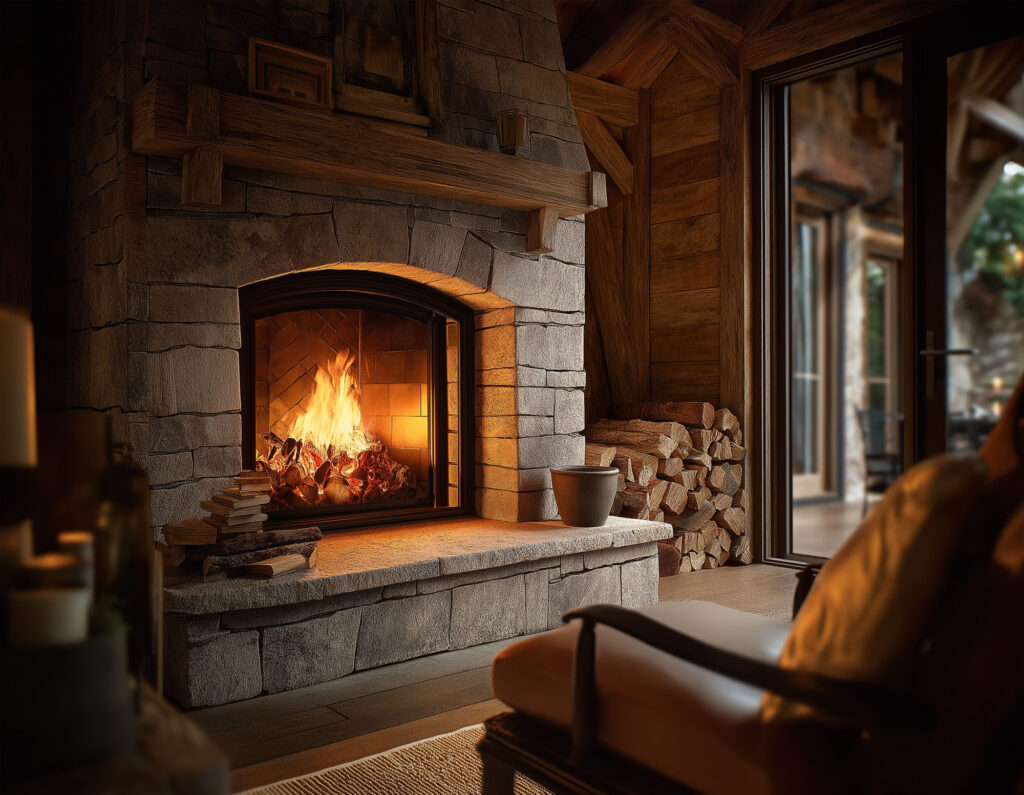
“True comfort begins not where a source of heat appears, but where the sensation of cold disappears.”
Novaspace Promo
When developing the La Rajoleria 1 project, our objective was to find a climate control system capable of delivering a high level of thermal comfort, outstanding energy efficiency, minimal impact on the interior design, and full compatibility with the Passive House philosophy. As a result, the project successfully obtained certification from the Passive House Institute (Germany), achieved the highest level of energy performance, and became the second Passive House Premium building in Catalonia and the eighth in Spain (ID: 7814).
Among the many engineering solutions available, our attention quickly focused on radiant heating systems. In practice, the choice ultimately came down to two options: underfloor heating and radiant ceiling heating. In this article, we would like to share the key conclusions we reached during our analysis of these technologies.
For many years, underfloor heating has remained one of the symbols of residential comfort. An entire industry has grown around it, and its advantages have become part of the conventional understanding of what a comfortable modern home should offer. One of the most common arguments, frequently repeated even by industry professionals, is that heat rises from the floor upwards and therefore underfloor heating must be the most efficient possible heating system, capable of warming an entire home evenly.
At first glance, the argument appears convincing. Warm air is indeed less dense than cold air and therefore tends to rise. However, this raises an awkward question. What does that fact actually have to do with underfloor heating?
In reality, underfloor heating is not a system whose effectiveness relies primarily on air convection. Unlike radiators, convectors or fan coil units, a significant proportion of its energy is transferred through thermal radiation. This is precisely why, in Spanish, Catalan and Portuguese, the technology is known as suelo radiante, terra radiant and piso radiante, terms that literally mean “radiant floor”. The name itself describes the physical principle behind its operation.
To better understand how it works, it is worth recalling a situation many people have experienced at a ski resort. The air temperature is minus five degrees Celsius, snow covers the landscape, and yet on a sunny, windless winter day it feels warm enough to remove a hat and open a jacket. The source of that comfort is solar radiation, which transfers energy directly to clothing and exposed skin. The energy delivered by the sun through infrared radiation is sufficient to make us forget about the freezing air surrounding us.
So how does the sun eventually warm the air? First, it heats vast surfaces such as the ground, rocks, buildings and other objects. These surfaces then gradually transfer their stored energy to the air. Underfloor heating works in much the same way. A significant portion of the energy transmitted through infrared radiation is first absorbed by the surfaces within the building and only later, through a combination of heat exchange processes, contributes to the creation of a comfortable indoor climate.
It was at this point that we began asking ourselves a fundamental question. If energy is transferred by radiation, where is the most effective location for a radiant surface?
To answer that question, imagine that infrared radiation becomes visible and that the floor turns into a giant light source. Which surfaces would be illuminated first?
The ceiling, above all else. Then the undersides of tables, chairs, sofas, beds and other furniture. Some of the energy would reach a person’s feet when standing or sitting. However, most of the body would remain in the shadow cast by furniture and interior elements. In other words, a considerable portion of the energy would initially reach surrounding surfaces rather than the person.
This does not mean the system performs poorly. It functions exactly as designed. However, this approach has an important consequence. Before a person experiences full thermal comfort, the energy must travel a long path. First the pipes or electric heating elements warm up. Then the screed. Then the floor finish. Then the surrounding surfaces. Only afterwards does the stored energy begin actively contributing to a comfortable indoor environment.
This is why underfloor heating is a system with significant thermal inertia. It is excellent for maintaining stable temperatures over long periods under an “on in autumn, off in spring” operating philosophy, but it is far less suited to situations where heating demand changes rapidly.
Many users of underfloor heating have experienced a paradoxical situation: their heels are already beginning to brown while the rest of the body is still shivering from the cold. The reason is not a lack of heating capacity, but rather the system’s inertia and the location of the radiant surface. A significant amount of energy has already reached the floor and nearby surfaces, yet overall thermal comfort has still not been achieved.
This question was particularly important to us because we build homes on Spain’s Mediterranean coast. The climate here is fundamentally different from that of Northern Europe. Even in winter, solar energy can significantly alter a building’s thermal balance within a matter of hours. During the day, solar gains may be sufficient to eliminate the need for heating altogether, while by evening additional heating may once again become necessary.
Imagine a typical winter day. The house is warmed by the sun during the afternoon, and the heating system is switched off. However, for the system to return to an effective operating condition by evening, it may require many hours. As a result, a paradox emerges: by the time the system begins working at full effectiveness, the need for it may already have disappeared, and vice versa.
This led us to look at the issue from a different angle. Perhaps the question is not only how much energy is transferred. Perhaps it is equally important how quickly that energy reaches the person.
If we imagine the same radiant surface located on the ceiling rather than the floor, the situation changes dramatically. Most of the human body is now within the direct field of radiation. There is no longer a need to warm a vast number of intermediate surfaces first. Energy begins affecting the occupant almost immediately after the system is activated.
In a certain sense, this situation is much closer to the example of the winter sun in the mountains. The source of energy is located above us and interacts directly with the human body rather than through numerous intermediate thermal storage elements.
The subjective perception of comfort also changes dramatically. When radiation comes from above, most of the body is exposed to it simultaneously. The result is a feeling of uniform thermal comfort that does not depend on whether a person is touching the floor or not.
For this reason, the radiant ceiling system won by a landslide in the La Rajoleria 1 project. An additional advantage is that the same system can be used not only for heating in winter but also for cooling in summer. In cooling mode, the ceiling gently absorbs excess heat from the space, creating a comfortable sensation of freshness without draughts and without the drawbacks commonly associated with traditional air conditioning systems.
As for underfloor heating, in energy efficient buildings on Spain’s Mediterranean coast it ceases to solve a real problem. There are no longer any “cold floors” causing discomfort and, as a heating system for this region, its high thermal inertia makes it a relatively inefficient solution.
Vladimir Nazarchuk, 2026
NOVASPACE PROMO